Table of Contents
- Integration with 3D Printing
- AI-Driven Process Optimization
- Sustainable Materials and Practices
- Advancements in Medical Applications
- Automation and Robotics in Resin Casting
- Future Trends in Resin Casting
Resin casting stands as a pillar of versatility and innovation in the ever-changing landscape of manufacturing. Its ability to produce high-precision components—ranging from intricate prototypes to durable production parts—has only been enhanced by recent technological advancements. Integrating next-generation methodologies, such as additive manufacturing, artificial intelligence, and sustainable processes, has unlocked new dimensions for industries seeking efficiency and customization. For those searching for expert services like urethane and silicone casting Essex, MA, the modernization of resin casting opens avenues to superior manufacturing results and tailored solutions across market sectors.
This shift toward digital integration, eco-conscious material choices, and automated workflows is transforming how manufacturers approach product development. The synergy of resin casting with 3D printing slashes turnaround times for custom components, while AI-driven process optimization challenges traditional constraints related to quality control and waste. At the same time, significant efforts are being invested in making resin casting methods more environmentally friendly, a necessity in a world increasingly attuned to sustainability. As these innovations shape the field, manufacturers and engineers must stay current on the technologies and best practices that guide progress in resin casting.
Integration with 3D Printing
The combination of resin casting and 3D printing is revolutionizing the manufacturing industry by enabling the quick creation of highly detailed and complex mold patterns. Through additive manufacturing, companies can bypass lengthy traditional mold-significant processes and instead create intricate designs with fast iteration cycles. This strategy accelerates prototyping, facilitates rapid feedback, and significantly reduces the time required to launch new products. The ability to update digital designs and print revised molds on demand also means manufacturers can stay responsive to shifting project requirements or custom requests without the delays associated with retooling. According to Engineering.com, integrating additive manufacturing with resin casting allows for the production of parts that are challenging or even impossible to achieve with traditional machining or molding techniques.
AI-Driven Process Optimization
Artificial intelligence is rapidly becoming an essential tool for precision and quality in resin casting. By utilizing sophisticated machine learning algorithms that analyze vast datasets from past and current casting runs, manufacturers can identify the most effective parameters for curing time, temperature, and resin flow. This level of control significantly reduces the risk of defects, minimizes material wastage, and ensures strict adherence to quality standards. AI-driven systems can adapt to real-time fluctuations in production environments, optimizing processes with a level of accuracy that far exceeds traditional manual oversight. Implementing AI in manufacturing has been widely recognized by industry leaders as a major step towards a smarter, more efficient production floor.
Sustainable Materials and Practices
With mounting regulatory pressures and growing consumer awareness regarding the environmental impacts of manufacturing, sustainability is now at the heart of resin casting innovation. New bio-based and recycled resin options aim to decrease dependence on petroleum-based resources. These alternatives not only minimize environmental footprints but also comply with evolving global standards. Manufacturers can now offer products derived from renewable resources, and the emergence of biodegradable and easily recyclable resins sets a standard for greener manufacturing practices. These practices reduce toxic emissions and resource waste, while enabling companies to appeal to both environmentally conscious consumers and regulators.
Advancements in Medical Applications
Resin casting has made notable advances within the medical field, particularly for patient-specific devices. For example, next-generation orthopedic casts—such as those developed by Cast21—utilize breathable, waterproof resins that offer better comfort and hygiene compared to traditional plaster. This not only improves the healing process but also makes aftercare more manageable. Customized dental molds, prosthetics, and hearing aids are now also possible through resin casting methods, supporting the move toward personalized medicine. The ability to customize and rapidly produce medical components enhances patient outcomes and improves provider flexibility, as detailed in resources from the National Institutes of Health.
Automation and Robotics in Resin Casting
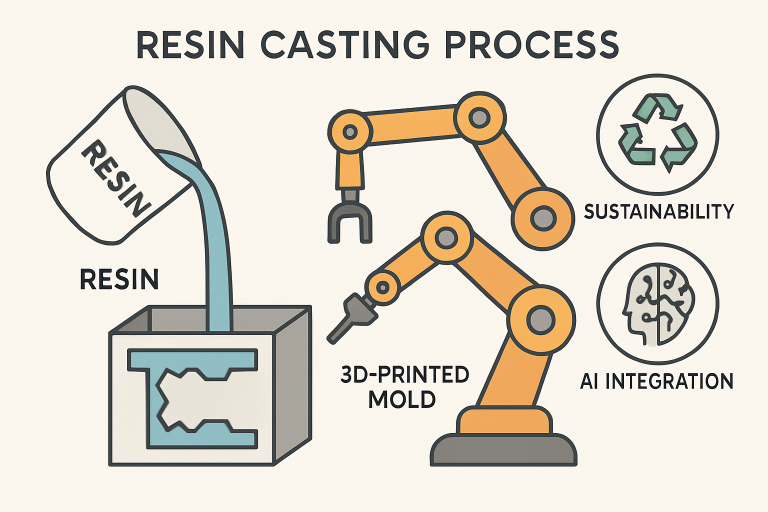
Automation and robotics have become central to scaling resin casting output while maintaining consistency in quality. Automated systems oversee critical tasks, including mold preparation, material dispensing, and part extraction. Not only does this reduce reliance on manual labor, which helps mitigate human error, but it also boosts productivity and repeatability across long production runs. Robotic arms enable the precise and quick loading and unloading of molds, ensuring the timely processing of multiple casting projects. Advanced dosing systems can reliably mix and dispense resin, guaranteeing uniformity in each batch and further enhancing product quality and reliability across the manufacturing cycle.
Future Trends in Resin Casting
The trajectory of resin casting is set towards further digitalization and material innovation. The ongoing adoption of AI and machine learning promises even more adaptive manufacturing environments, continually refining processes based on historical outcomes and real-time inputs. Meanwhile, the development of resins with increased strength, thermal resistance, and reduced curing times will be critical for applications in aerospace, automotive, and high-performance medical sectors. Partnerships between advanced resin formulators and foundry equipment manufacturers aim to deliver integrated, end-to-end casting solutions that lower costs and boost both speed and quality.
Ultimately, resin casting is positioned as a vital, future-ready solution for modern manufacturing challenges, merging tradition with transformation to satisfy the dynamic needs of today’s industries.